Australian Opal
What Makes Australian Opal So Rare — And Why Autumn Is the Time to Own One
Opal is October birthstone and it's almost here! And Christmas is not that far away.
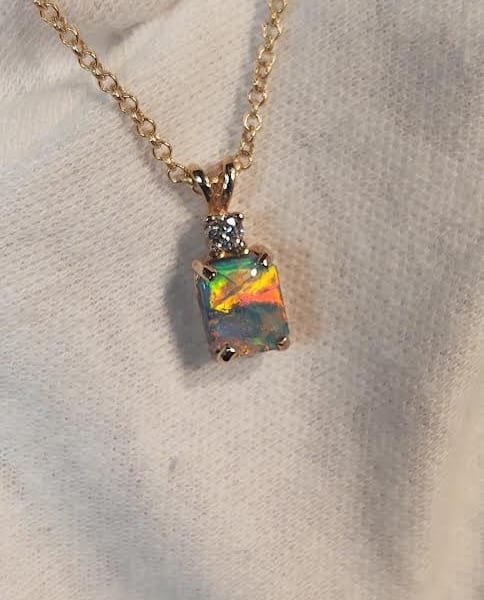
There is a moment — if you have ever held a quality Australian opal up to the light — when the stone seems to catch fire from within. Blues shift to greens, greens dissolve into reds, and the whole thing pulses like something alive. It is not a trick of the light. It is geology.
Australian opal is one of the most extraordinary gemstones on earth, and it is almost entirely found in one place. Understanding why it is so rare — and why that rarity matters — is the first step toward understanding why collectors and first-time buyers alike are paying close attention right now.
Australia Produces Over 95% of the World's Opal
No other country comes close. The vast majority of the world's precious opal comes from three regions in Australia: Lightning Ridge in New South Wales (home of the legendary black opal), Coober Pedy in South Australia (the self-proclaimed opal capital of the world), and the Queensland boulder opal fields.
This concentration is not a coincidence. It is the result of a very specific geological story that played out over 100 million years — and that story cannot be replicated anywhere else on earth.
How Opal Forms: A 100-Million-Year Process
Opal is not a crystal. It is an amorphous form of silica — essentially, a hardened gel — and it forms in a way that is almost impossibly slow.
During the Cretaceous period, much of inland Australia was covered by a vast shallow sea. As that sea retreated, it left behind silica-rich groundwater that seeped into cracks, voids, and the spaces left by decaying organic matter in the rock. Over millions of years, that silica slowly dried and hardened.
The play of color — the fire that makes opal so captivating — comes from the internal structure of the stone. Tiny spheres of silica, arranged in a regular grid, diffract light as it passes through them. The size of those spheres determines which colours you see. When the arrangement is perfect, you get the full spectrum. When it is not, you get a stone with no play of colour at all — what is called "potch."
The conditions required to produce a gem-quality stone with strong, rolling fire are extraordinarily specific. Most opal found in the ground is potch. The stones that display true color are rare even within the opal fields themselves.
No Two Opals Are Alike
Unlike diamonds, which are graded on a standardized scale, every opal is genuinely unique. The pattern of colour, the base tone, the brightness, the way the fire moves as you tilt the stone — all of these are determined by the specific conditions under which that particular stone formed, in that particular crack, in that particular layer of rock.
This means that when you own an opal, you own something that has never existed before and will never exist again. It is not a category of gemstone. It is a specific object with a specific history.
For collectors, this is part of the appeal. For first-time buyers, it can feel overwhelming — but it is also what makes the experience of choosing an opal so personal.
The Different Types of Australian Opal
Not all Australian opal is the same, and understanding the main types helps you appreciate what you are looking at.
Black opal from Lightning Ridge is the most prized and the most valuable. The dark body tone — which ranges from dark grey to jet black — makes the colors appear more vivid and intense. A fine black opal with strong red fire is among the most valuable gemstones in the world, gram for gram.
Boulder opal from Queensland forms within ironstone boulders. The opal occurs in thin seams and veins within the rock, and the finished stone often retains part of the ironstone matrix. This gives boulder opal a distinctive, earthy character — and because the opal layer can be very thin, the stones are often cut to include the backing rock, which becomes part of the aesthetic.
Crystal opal is transparent or semi-transparent, allowing light to pass through the stone rather than reflecting off a dark base. The colors appear to float inside the stone, giving it an almost liquid quality.
White opal from Coober Pedy has a light or white body tone. It is the most commonly seen type and ranges from stones with very little color to exceptional pieces with strong, rolling fire across the full spectrum.
Why Collectors Are Paying Attention Right Now
The opal market has changed significantly over the past decade. As awareness of Australian opal has grown internationally — particularly in Asia and North America — demand for quality stones has increased while supply has remained constrained.
The opal fields are not infinite. Lightning Ridge, in particular, has been mined for over a century, and the most accessible and productive areas have been worked extensively. Finding new deposits requires deeper mining, greater investment, and more risk. The stones that come out of the ground today are often harder-won than those of previous generations.
At the same time, the craft of opal cutting and setting has become increasingly recognized as an art form in its own right. Buyers are not just purchasing a stone — they are purchasing the judgment and skill of the person who selected it, cut it, and set it.
For anyone who has been curious about opal but has not yet made the leap, the combination of constrained supply, growing international demand, and the irreplaceable uniqueness of each stone makes this a compelling moment.
What to Look for When Buying Australian Opal
If you are new to opal, a few principles will serve you well.
Brightness matters more than color. A stone with strong, vivid fire — even if it shows only one or two colors — is generally more valuable than a dull stone showing the full spectrum. Brightness is the quality that makes an opal come alive.
Pattern adds value. Certain patterns — rolling flash, harlequin, pinfire — are particularly prized. A stone with a distinctive, well-defined pattern will typically command a premium.
Body tone affects everything. On a dark base, colors appear more saturated and intense. On a light base, they can appear softer and more diffuse. Neither is inherently better — it is a matter of preference — but body tone is one of the primary factors in valuation.
Provenance matters. Knowing where a stone came from — which field, which mine — adds to its story and, increasingly, to its value. Ethically sourced, traceable opal is becoming more important to buyers who care about the full history of what they own.
The Opal Watching Approach
We cut, polish and set each piece ourselves. You can purchase ready made opal jewelry from us or we can design a custom piece of jewelry to your specifications. We can re-polish, repair or replace opals in jewelry you own. We can also replace most other stones in your existing or vintage jewelry with opal to create an exciting new look.
If you have been thinking about owning a piece of Australian opal, our Fall Sale is now open. It is a rare opportunity to acquire opal jewelry at a once-a-year price, from people who know where every stone came from.
Every opal tells a story. This one could be yours.